
Destined for Hell

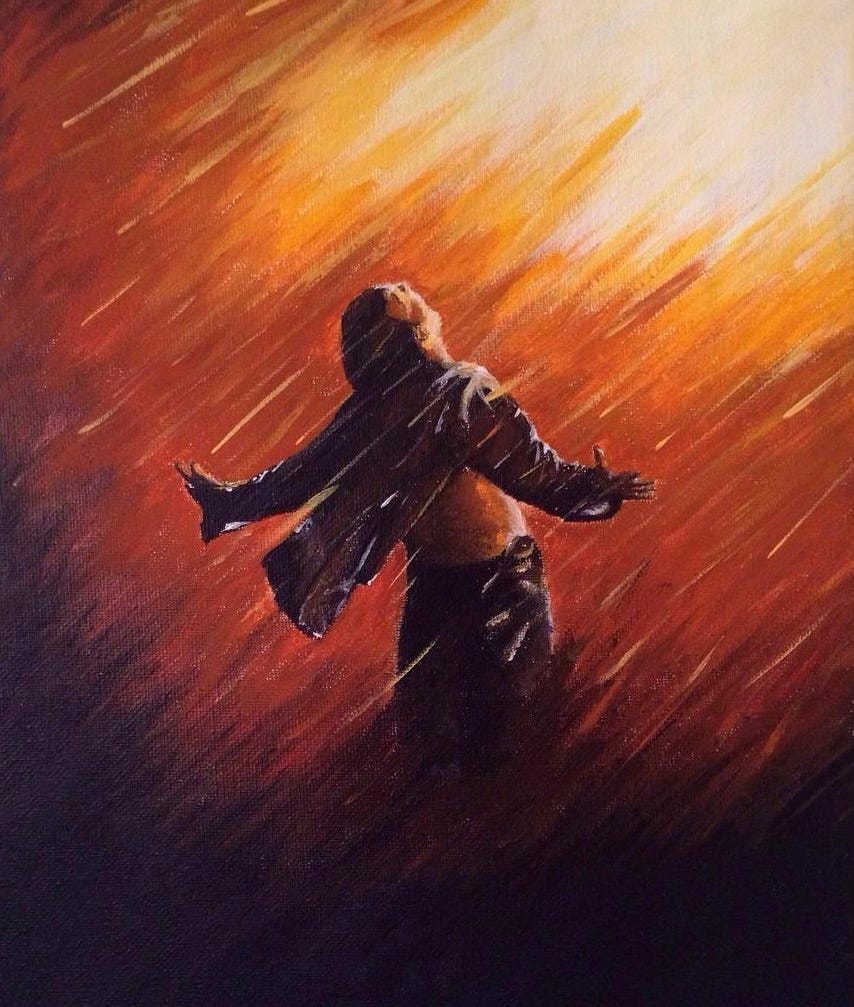
I spent years trying to love a God I was mostly afraid of.
That feels like a cruel thing to admit.
Yet every time I wandered too far, every time I loosened my grip on belief, it was not love that pulled me back. It was fear. Fear of punishment. Fear of death. Fear of being wrong.
For years, I mistook that fear for faith. I mistook anxiety for devotion, guilt for conviction, and obedience for love. Every return felt meaningful at the time, proof that some part of me still believed. But looking back now, I wonder if it was ever belief at all.
It was never love that brought me back.
It was fear disguised as devotion. And heaven…I grieve it. I built so much of myself around its promise. I stored my dead there. I placed every goodbye inside it. Every loss became bearable because it was temporary and led me back to “my heaven”. Every injustice became tolerable because there would be another world where everything would finally make sense. Through gritted teeth I endured while gripping onto the reminder of my eventual home.
It’s a strange kind of grief, mourning something twice. Once when it is lost, and again when you discover it may never have existed at all.
People tell me faith brings comfort.
Perhaps it does.
But I remember the anxiety more clearly.
I remember standing at the sink, washing my hands, my mouth, my face, my arms. Then doing it again. And again. Wondering if I had missed a spot. Wondering if I had invalidated the prayer before it had even begun.
I remember apologising for thoughts before I had even finished thinking them. I remember interrogating my own mind as though it were a crime scene. I remember treating curiosity like a sin.
Questions arrived naturally.
Guilt arrived immediately after.
I began to suspect that my destination had already been decided and it was not the heaven I’d envisioned.
I spent years in a state of cognitive dissonance, nodding along to things I could not reconcile with myself, agreeing until I remembered I was not supposed to.
For years I called it weakness.
Now I wonder if it was simply honesty.
And perhaps that honesty began to spill into other parts of my life. The same questions I had about God eventually followed me into my relationships with other people.
I always hated the phrase, “I love you for the sake of God.” People said it with sincerity. I know they did. But every time I heard it, something inside me recoiled.
Why not love me for me?
Why not love me for the conversations, the laughter, the silences, the parts of myself that exist independent of heaven and hell?
Was I ever enough on my own?
Perhaps that is why friendship feels so fragile now.
I can already feel the distance forming.
Not because I have harmed anyone. Not because I have become cruel. But because my doubt would be considered corruption, my proximity contagious.
When someone once stood beside them in prayer and no longer can, the embrace becomes hesitant. The conversations become careful. The warmth becomes conditional.
I do not know how many people love me, and how many love the version of me they believe God approves of.
Lately, I have become haunted by the gap between who I am and who I appear to be.
I still speak the language.
The words remain.
They slip from my tongue out of habit, memory, inheritance.
I still carry the appearance of belief long after belief itself had departed.
Not as mockery.
Not as a costume.
But because faith, even when abandoned, leaves fingerprints everywhere.
In the words I use.
In the food I eat.
In the way I greet people.
In the memories of childhood.
Perhaps I still wear it because I do not know who I am without it.
Or perhaps because it is impossible to separate yourself completely from something that helped raise you. This is all I have ever known.
What does that make me?
A hypocrite?
A coward?
Or maybe just someone trying to figure it out.
I miss not having to carry the weight of existence alone. I miss placing my problems in the hands of another, believing my life had been perfectly planned for me, that everything happened for a reason.
Without that certainty, the responsibility landed on me all at once.
And it was crushing.
Sometimes I think it would have been easier if I hated it.
But I do not.
I understand why people believe.
I understand the comfort of certainty.
I understand the desire to be told that suffering means something.
I understand the longing to see the dead again.
That is what makes all of this so difficult.
I do not hate those who still believe. If anything, I am strangely protective of them. Because I know what it feels like to be afraid. I know what it feels like to desperately want it all to be true.
Although some may come to see me as misguided, corrupted, or lost, I could never bring myself to hate them in return. We were taught the same fears. We carried the same hopes. We looked toward the same sky.
And perhaps that is the saddest part of all.
Not that I was destined for hell.
But that I spent so much time believing I was.